Peptide Validation With Hplc & Ms
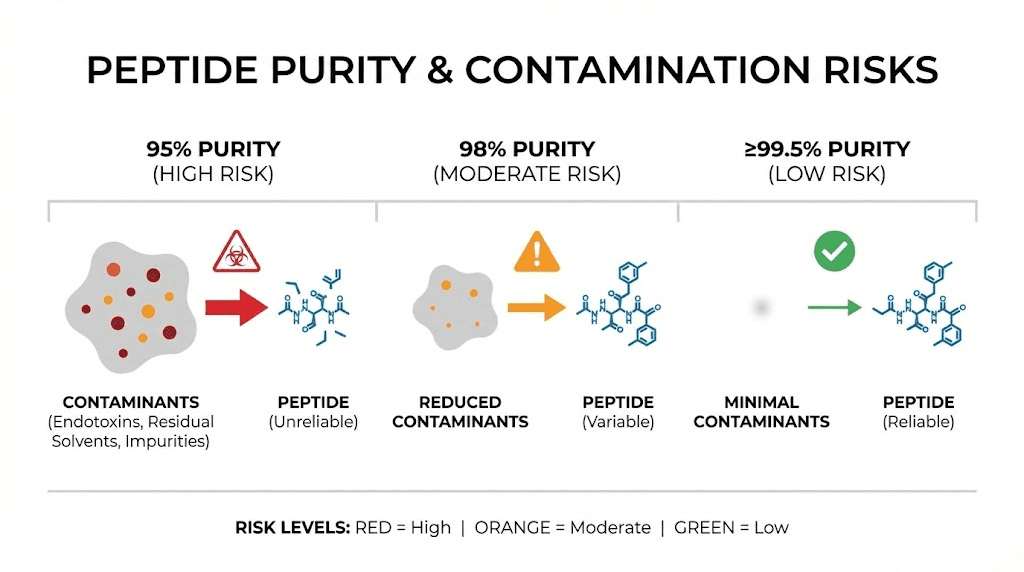
Why Hplc Pureness Screening Matters For Study Peptides 2026 NorthEast BioLab always surpasses expectations on bioanalytical assay growth, recognition, and sample evaluation. At Apex Peptide Supply, every peptide is validated via HPLC and MS screening, offering researchers self-confidence in their work and trusted outcomes every single time. Research-grade peptides need to have pureness levels of 98% or higher, with premium distributors offering 99.0% to 99.7% pureness. Higher purity guarantees better research outcomes and minimizes interference from pollutants. Yes, research peptides are lawful in the UK when sold and acquired purely for laboratory research objectives. Examinations need to include making use of confirmed logical approaches to examine identification, pureness, effectiveness, and security at every phase of the product's advancement and usage. We usually use slope elution in peptide pureness evaluation, that is, the percentage of natural stage (primarily acetonitrile) in the eluent slowly enhances with time. Since the price of addition of natural stage has a considerable effect on the purity outcome. We typically utilize a slope elution technique every minute (the concentration of acetonitrile boosts by 1% every min, v/v), which can prevent the overlap of example heights and impurity optimals and boost the precision of evaluation outcomes. This short article is provided for academic and research study recommendation purposes only. Partial peptide fragments can result from incomplete synthesis or post-synthesis destruction. These fragments are generally smaller sized than the target peptide and might elute at different retention times. HPLC can show the existence of added optimals; LC-MS can help designate likely identities to those related types. A solid peptide screening workflow uses techniques that answer corresponding questions. The table listed below is the useful means to consider usual examinations when checking out a peptide COA.
What Are The Standards Required For Ideal Quantitation During A Hplc Research Study?
Just how much time does an HPLC test take?
Time Required for HPLC EDTA Examination Records + Next Steps
The Parts Of An Hplc System
Unrefined peptides go through gel purification adhered to by HPLC purification. HPLC purification is done by the state-of-art HPLC system with Empower Chromatography Manager. The system is confirmed by licensed Waters validation expert Article source to comply with FDA requirements. The pureness of the peptide is confirmed by running analytical HPLC followed by mass spectrum evaluation. Scientists then determine how much of the total signal comes from the primary peak. If 98% of the signal originates from the appropriate peptide, the product is identified "98% pure by HPLC." This is a standard method of expressing peptide high quality across research and pharmaceutical industries. For instances of product-level context, compare the expected masses for Retatrutide, BPC-157, and Semaglutide. Each peptide has a different expected molecular weight, so mass verification is not a generic badge; it is compound-specific evidence. For a deeper identity-focused explanation, see Mass Spectrometry Peptide Confirmation. Security testing is used to control if the high quality of a medication material or medicine item is transformed gradually by many ecological factors, such as temperature level, light, and moisture. All peptides marketed by Prax Peptides are strictly intended for in-vitro research study and lab use just.- This links straight with managing subjects such as peptide storage space and peptide reconstitution.
- Regulatory companies closely keep track of peptide products, particularly those utilized in intensified medicine under 503a and 503b standards.
- It is a graph with time on the straight axis and detector response, generally UV absorbance, on the upright axis.
- The restrictions of hplc include reduced sensitivity and feasible intereference from various other optimals.